Marco Silva
April 2, 2026

Peptide Tracker Decision Diary: How to Use Stop Rules, Confidence Labels, and Safer Weekly Reviews
Most tracking systems fail in one of two ways: they are too loose to be trustworthy, or too strict to survive real life.
Peptide tracking sits exactly in that tension. People want useful insights, but life brings travel, poor sleep, stress spikes, schedule drift, and inconsistent notes. If the method cannot handle messy weeks, users either overinterpret noise or abandon the tracker.
A practical middle path is a decision diary: a process that separates observation from interpretation, labels confidence explicitly, and uses stop rules to prevent risky overreach. This article lays out a safety-first workflow for informational self-tracking. It does not provide dosing instructions and does not offer diagnosis, treatment, or cure claims.
Why a decision diary beats a raw log
A raw log tells you what happened. A decision diary tells you how you reasoned.
That difference matters because memory edits itself. After a rough day, many people unconsciously rewrite the week: one bad event becomes “this always happens.” A decision diary adds friction against that drift by recording:
- what was observed,
- what was inferred,
- confidence level,
- and what could disconfirm the inference.
You are not trying to sound certain. You are trying to stay honest.
Core model: observation, interpretation, action
For each weekly review, use three separate lines.
- Observation: facts from logs only.
- Interpretation: a tentative pattern statement.
- Action: a low-risk next step for data quality or clinical discussion.
Example:
- Observation: four evenings had reduced function scores after short sleep nights.
- Interpretation: possible relationship, but confounded by deadline stress.
- Action: keep same scoring anchors for one more week; flag for clinician discussion if repeated under lower stress.
This structure prevents you from jumping straight from chart movement to high-stakes conclusions.
Confidence labels that force proportion
Every interpretation should carry a confidence label. Use a small fixed scale:
- C0 — Insufficient data: no meaningful inference.
- C1 — Weak signal: pattern appears, heavily confounded.
- C2 — Moderate signal: repeated pattern with acceptable completeness.
- C3 — Strong observational signal: repeated under stable definitions and lower confounder burden.
In many weeks, C0 or C1 is the correct answer. That is not failure. It is good measurement behavior.
Stop rules: your anti-overreaction guardrail
Stop rules are prewritten conditions that automatically pause aggressive interpretation.
Suggested stop rules:
- If daily completion drops below 70%, no conclusions above C1.
- If more than two days are backfilled from memory, no directional claims.
- If confounder load is high on most days, classify as unresolved week.
- If scoring definitions changed midweek, split the week into pre/post segments.
- If severe or rapidly worsening symptoms appear, stop self-interpretation and seek professional care.
Stop rules are useful because they run when emotions run hot. You do not negotiate them in the moment.
Build a baseline before pattern hunting
Pattern hunting without baseline is a recipe for false alarms.
Baseline window suggestion:
- minimum 14 days,
- fixed anchors for symptom and function scales,
- consistent check-in timing,
- explicit logging of major context factors.
During baseline, avoid dramatic interpretation language. Your goal is to establish normal variability range. Once you know what “ordinary fluctuation” looks like, you can better detect meaningful deviation.
The confounder register: short, standardized, non-negotiable
Use a compact confounder list and keep it stable for months.
Common categories:
- sleep disruption,
- acute stress event,
- travel/time-zone shift,
- illness signs,
- unusual physical exertion,
- major schedule disruption.
Mark presence/absence daily. If needed, add a simple intensity flag (low/medium/high). Avoid verbose narratives in the core register; those can go in notes. Standardization makes weekly comparison possible.
Data quality score (DQS): one number for weekly trust
To avoid hand-wavy judgments, assign a weekly Data Quality Score from 0 to 100.
Simple model:
- Completeness (0–40)
- Timeliness of entry (0–20)
- Confounder documentation quality (0–20)
- Scale consistency/no drift (0–20)
Then attach interpretation limits:
- DQS < 60: descriptive only, no pattern claims.
- DQS 60–79: tentative pattern language, max C1/C2.
- DQS 80+: pattern review allowed with counterfactual check.
One number will never capture everything, but it creates consistent discipline.
Counterfactual check: mandatory before any “pattern” label
Before you label a trend, write one plausible non-primary explanation.
Template:
- Primary read:
- Plausible alternative:
- What evidence next week would separate them?
If you cannot generate a plausible alternative, you may be too close to the data. Ask for external review or pause interpretation until another week of cleaner observations.
Version control for your own scales
People think they use the same 1–10 scale forever. They usually do not.
Add scale versions (v1, v2, etc.) whenever anchor definitions change. Document exactly what changed and when. In analysis, never blend v1 and v2 data without marking a break.
This sounds technical, but it prevents quiet drift that ruins comparisons over time.
Weekly review in 20 minutes
A realistic review routine:
- 5 minutes: completeness + timeliness audit.
- 5 minutes: confounder distribution review.
- 5 minutes: observations only (no interpretations yet).
- 3 minutes: interpretation with confidence label.
- 2 minutes: next action and stop-rule check.
Keep it short on purpose. Long review rituals die first when life gets busy.
Monthly safety audit
Once per month, review the process itself:
- Are fields still decision-relevant?
- Are any scales frequently misunderstood?
- Are stop rules too loose or too strict?
- Are privacy settings and backup habits still acceptable?
- Are clinician-facing summaries actually readable?
Delete fields that produce work but no decision value. A tracker should become lighter and clearer over time.
Red flags that require caution in interpretation
Treat the following as automatic confidence reducers:
- inconsistent logging times with heavy backfill,
- sudden change in scoring behavior,
- too many missing context tags,
- sharp chart movement during high-confounder periods,
- conclusions that sound stronger than the underlying data quality.
When red flags cluster, downgrade confidence. The goal is not to win an argument with your own chart.
Building clinician-ready summaries
If you discuss patterns with a healthcare professional, deliver a concise summary:
- timeline of observed changes,
- frequency and severity distribution,
- confounder context,
- confidence labels,
- direct questions you want answered.
Avoid sending a giant export with no framing. Clinicians can help more when your uncertainty is explicit and your questions are specific.
Privacy and governance basics
Tracking can expose sensitive routines and health-related context. Keep governance practical:
- use strong authentication,
- minimize unnecessary sharing,
- prefer encrypted backups where possible,
- avoid posting raw logs in public or semi-public channels,
- define what gets deleted after it is no longer useful.
Data minimization is a feature, not a limitation.
What to do after a chaotic week
Chaotic weeks happen. Do not overcorrect.
Recovery protocol:
- label the week “degraded quality,”
- suspend high-confidence interpretation,
- return to minimum viable daily entries,
- restore full weekly review only after several stable days.
The worst move is pretending noisy data is clean because you want closure.
Language rules that improve safety
Ban these phrases from your review notes:
- “proved,”
- “definitely caused by,”
- “always,”
- “never.”
Prefer language like:
- “possible association,”
- “preliminary observation,”
- “requires replication,”
- “confidence limited by confounding.”
Language affects behavior. Better wording leads to better decisions.
Decision diary template you can reuse
For each week:
- Week quality: DQS score + key limitations
- Top observations (max 3): fact-only statements
- Interpretations (max 3): each with C0–C3 confidence
- Counterfactuals: one per interpretation
- Stop-rule status: passed/failed + why
- Next-step plan: low-risk, process-focused actions
- Escalation note: whether professional input is recommended
If the template feels repetitive, good. Reliability is repetitive.
Common mistakes and safer replacements
-
Mistake: changing multiple variables and then interpreting trend direction.
- Safer replacement: prioritize consistency windows before comparison.
-
Mistake: ignoring confounders because they are “obvious.”
- Safer replacement: tag confounders even when obvious; future-you forgets.
-
Mistake: reviewing only bad days.
- Safer replacement: include neutral/good days to avoid negative sampling bias.
-
Mistake: treating one unusual week as a new baseline.
- Safer replacement: require repeated appearance across cleaner weeks.
Operational resilience: making the method survive bad weeks
A durable tracker is designed for the worst week, not the best week. Add resilience rules that activate automatically during overload periods.
- Switch to a “minimal logging mode” with only core fields when time is scarce.
- Add a backlog marker instead of fake precision when entries are delayed.
- Freeze interpretation until at least three consecutive days are logged on time.
- Mark extraordinary events explicitly so they are reviewed as context, not trend.
Resilience rules protect continuity. Continuity protects quality. And quality protects decision safety.
Final perspective
Good peptide tracking is not about certainty theater. It is about disciplined uncertainty management.
A decision diary, confidence labels, and stop rules help you avoid two expensive errors: overreacting to noise and ignoring context. Over time, this produces records that are safer, clearer, and more useful for informed medical conversations.
If your process increasingly says “insufficient evidence this week,” that may be progress—not failure. It means your standards are improving.
Informational content only; not medical advice. No diagnosis, treatment, or cure claims.
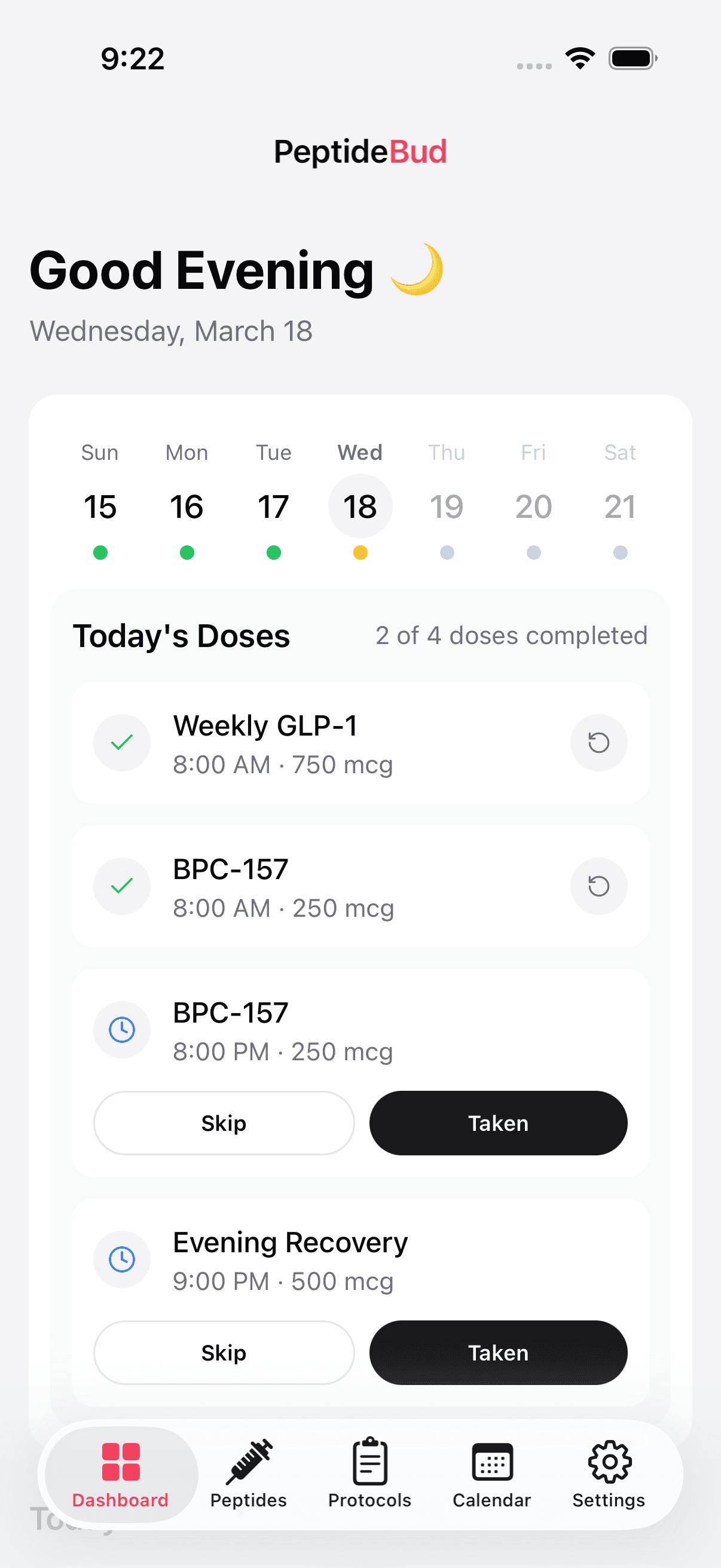
Track your peptides. Download PeptideBud today.