Marco Silva
April 7, 2026

Peptide Tracker Baseline Windows: A Practical Method to Compare Weeks Without Chasing Noise
A tracking system can look busy and still be unreliable. That is the trap. When people review peptide logs after a demanding month, they often see movement in the chart and assume the movement means something. Sometimes it does. Often it reflects schedule chaos, missing context, or inconsistent entry habits rather than a stable pattern.
This guide focuses on one specific skill: building baseline windows so weekly comparisons become less noisy and more honest. It is educational content only. It does not provide dosing guidance and does not make diagnosis, treatment, or cure claims.
Why baseline windows matter
Most personal logs are compared day by day. That is intuitive but fragile. Daily comparisons are sensitive to sleep disruption, unusual workload, travel, social obligations, and late-entry recall bias.
Baseline windows use fixed blocks of time with predefined quality checks. Instead of asking “What happened yesterday?” you ask “How does this full week compare to another full week with similar data quality?”
That single change reduces overreaction.
Define your review units before looking at outcomes
Pick one review unit and keep it stable for at least eight weeks:
- 7-day blocks if your schedule is relatively consistent
- 14-day blocks if your week-to-week context swings a lot
- month blocks only if entry completeness is high and steady
Do this before outcome review. If you switch units after seeing the graph, you can accidentally optimize for a preferred story.
Build a minimum viable entry structure
You do not need a giant form. You need reliable essentials. A practical entry has five parts:
- timestamp and entry window,
- core observation markers,
- confounder tags,
- completeness status,
- short free-text context.
Confounders are non-negotiable. If the system tracks outcomes but ignores context, you will repeatedly mistake disruption effects for meaningful changes.
Confounder tags that actually help
Use a short controlled set. For example:
- sleep-short
- travel-day
- shift-schedule
- hydration-low
- unusual-stress
- illness-symptoms
- high-activity-day
Keep names consistent. No aliases. No punctuation variants. If you need a new tag, add it during weekly review, not in the middle of a stressful day.
Baseline eligibility rules
A window should only be compared if it passes minimum quality thresholds. Example thresholds:
- at least 80 percent of expected entries present,
- no more than two reconstructed entries,
- confounder tags present when applicable,
- no unresolved schema changes inside the window.
When a block fails eligibility, keep it for records but downgrade interpretation confidence.
Confidence tiers for pattern claims
Pattern language should match evidence quality. Create explicit tiers:
- low confidence: exploratory observation, do not infer trend,
- moderate confidence: repeated pattern with known caveats,
- high confidence: stable pattern across multiple eligible windows.
This prevents all-or-nothing thinking. Not every period needs a strong claim.
The two-axis comparison model
For each window, evaluate two axes separately:
- signal axis: how consistent are the target markers,
- quality axis: how trustworthy is the underlying data.
High signal with poor quality is not a strong finding. Low signal with excellent quality can still be useful, especially when it rules out a suspected pattern.
Entry timing discipline
Late entries introduce memory distortion. Set a timing rule:
- routine entries within a defined same-day window,
- next-day backfill allowed but flagged,
- older reconstruction allowed only with explicit confidence notes.
A simple timing flag is often more valuable than adding three extra symptom fields.
Weekly review script (20 minutes)
Use the same script every week:
- check entry completeness,
- resolve naming drift,
- verify confounder usage,
- mark reconstructed items,
- assign confidence tier,
- write a 6-line summary.
Repeatability beats brilliance here.
How to write a useful 6-line summary
Keep summaries constrained. Template:
- period covered,
- completion percentage,
- frequent confounders,
- observed directional changes,
- confidence tier and why,
- next review question.
Short summaries reduce narrative inflation and make monthly aggregation easier.
Monthly synthesis without overclaiming
At month end, aggregate only eligible windows first. Then report:
- number of eligible windows,
- number of ineligible windows and causes,
- repeated markers seen in eligible windows,
- unresolved uncertainties,
- questions for licensed clinician discussion.
If most windows are ineligible, the right conclusion is process improvement, not pattern declaration.
Drift detection: the silent failure
Systems drift slowly. Labels get reused loosely, scale anchors change, and “normal” shifts without documentation. Run drift checks monthly:
- are scale anchors still interpreted the same way,
- are tags being used as intended,
- are narrative notes replacing structured fields,
- did any field definition change without a date stamp.
If drift is found, mark a boundary date and avoid direct pre/post comparisons until migration notes are complete.
Keep analysis and action separate
A tracker should document and frame discussion; it should not impersonate medical decision-making. Keep two distinct outputs:
- analytical output: what the data quality supports,
- action output: what to discuss with a licensed professional.
That separation lowers risk, especially during stressful weeks when people want immediate certainty.
Handling gaps without pretending they do not exist
Missing data is common. Treat it honestly:
- expected-but-missing,
- not-applicable,
- unknown.
These are different states. Collapsing them into blank cells inflates confidence and distorts trend interpretation.
Build a “do not compare” list
Not all windows should be compared directly. Keep a do-not-compare list for periods with major disruptions, such as long-haul travel, acute unrelated illness, or large schedule inversions.
These periods still matter for documentation. They are just poor anchors for trend claims.
Collaboration-ready exports
If you share summaries with a clinician, package context first:
- glossary of marker definitions,
- confidence-tier rubric,
- confounder taxonomy,
- boundary dates for schema changes,
- top three discussion questions.
Good exports reduce interpretation friction and help keep conversations focused.
Guardrails against confirmation bias
Use three guardrails:
- predefine comparison windows,
- predefine confidence language,
- document one alternative explanation for each observed shift.
You do not eliminate bias, but you make it visible.
Operational checklist for next week
Before the next cycle starts:
- lock your confounder tag list,
- set baseline eligibility thresholds,
- add timing flags for late entries,
- schedule one weekly review slot,
- define confidence tiers in writing,
- prepare a one-page monthly synthesis template.
This setup usually takes less than an hour and pays back quickly through calmer reviews.
What progress looks like after two months
Practical improvement is boring by design:
- fewer contradictory week-to-week claims,
- faster summary writing,
- clearer uncertainty statements,
- better clinician handoff quality,
- less anxiety from chart noise.
You are not aiming for dramatic certainty. You are building dependable documentation under real-life conditions.
A lightweight scorecard you can maintain
Many people ask for one number that summarizes tracker quality. A single score can hide too much, but a small scorecard is useful. You can maintain four separate 0-5 ratings each week:
- completeness quality,
- context quality,
- timing quality,
- interpretation discipline.
Completeness quality asks whether expected entries were captured. Context quality asks whether confounders were properly tagged. Timing quality asks how much of the week was entered in the intended time window. Interpretation discipline asks whether claims matched evidence tier language.
Keep these ratings separate. If you combine them into one number, a strong area can hide a weak area.
Practical examples of safer language
Language control makes a measurable difference in summary quality. Compare these pairs:
-
weak: “clear improvement happened this week”
-
safer: “markers moved in a favorable direction in one eligible window; confidence remains moderate due to travel confounders.”
-
weak: “this pattern proves the routine works”
-
safer: “the pattern repeated across two eligible windows; additional windows are needed before high-confidence interpretation.”
-
weak: “bad week means regression”
-
safer: “this window was ineligible for trend comparison because missing data exceeded threshold.”
This wording is less dramatic, but it is substantially more reliable.
If your schedule is unpredictable, use rolling anchors
Some people cannot maintain neat Monday-to-Sunday windows. In that case, use rolling anchors:
- choose an anchor event that occurs regularly,
- build fixed-length windows relative to that anchor,
- keep the same rule for at least eight weeks.
For example, if work rhythm resets every Thursday, start windows on Thursday rather than forcing a calendar week. The point is consistency, not tradition.
Recovery plan after a messy month
If a month is chaotic, do not try to retroactively perfect every entry. Use a recovery plan:
- label all reconstructed entries clearly,
- classify all windows by eligibility,
- archive unresolved ambiguity as explicit unknowns,
- restart the next month with strict timing and confounder discipline.
Recovery plans protect continuity. Perfection attempts usually create more hidden distortion.
Keep your system boring on purpose
The most durable trackers are intentionally boring. They avoid weekly redesigns, fancy metric churn, and constant scale changes. Boring systems survive stress.
A good rule: if a schema change cannot explain exactly how it improves interpretation safety, postpone it.
Final note
A peptide tracker becomes valuable when it combines structure, context, and disciplined confidence language. Baseline windows, eligibility thresholds, and confounder-aware reviews do not make data perfect. They make it interpretable.
Reliable interpretation is the real upgrade.
Educational content only. Not medical advice. No dosing instructions, diagnosis, treatment, or cure claims.
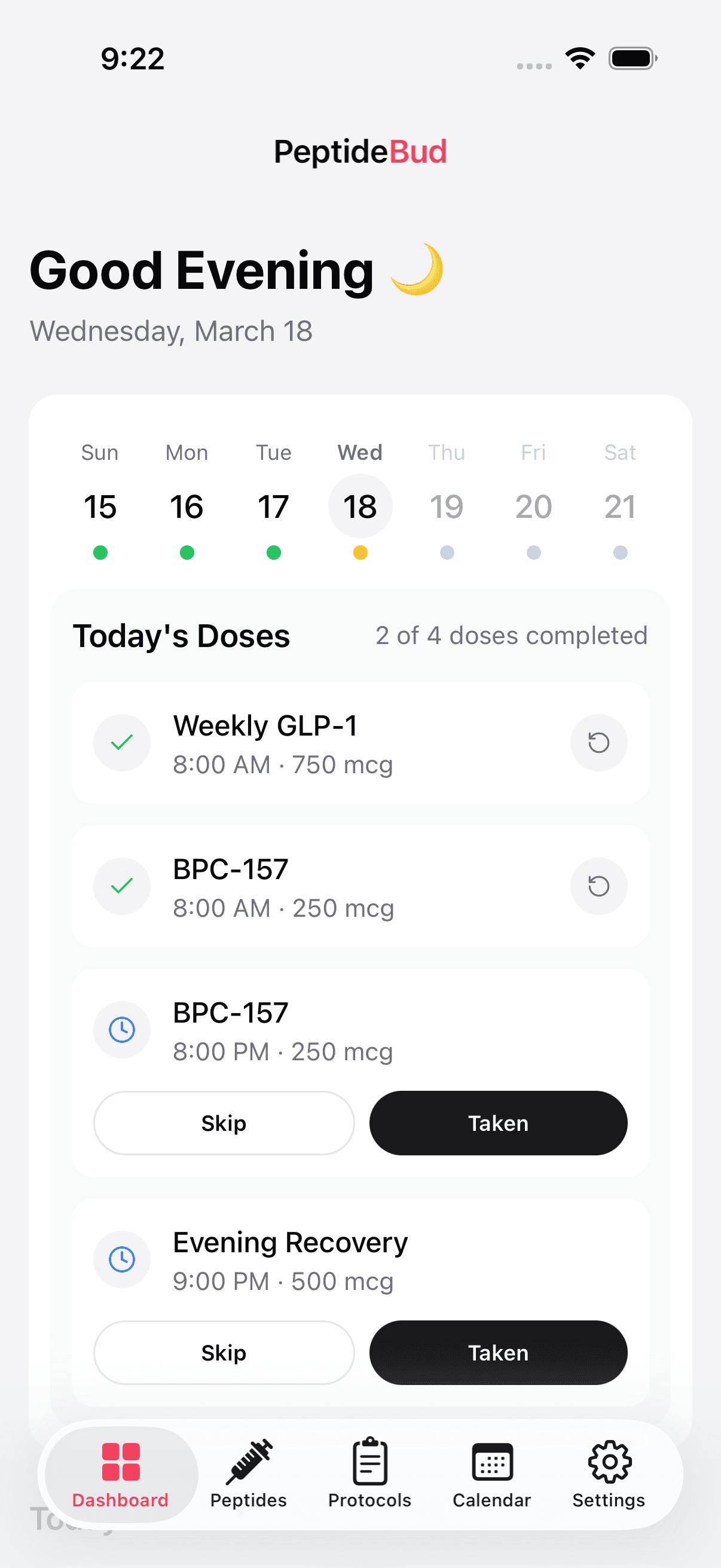
Track your peptides. Download PeptideBud today.