Marco Silva
March 17, 2026

Peptide Tracking Without Guesswork: A Safety-First System for Baselines, Confounders, and Weekly Decisions
Peptide discussions online are loud, fast, and often confident. Real-world data usually is not. Most people trying to track outcomes run into the same problem: they collect lots of notes, but those notes do not help them make clear, safer decisions.
That gap is not because people are lazy. It is because tracking systems are often too complex, too emotional, or too inconsistent to hold up over time. You cannot learn much from records that change format every week or from entries that only appear on very good or very bad days.
This guide gives you a practical framework to track peptide-related observations in a way that is realistic, non-diagnostic, and useful in conversations with licensed medical professionals. It does not provide treatment plans, diagnosis, or dosing advice.
What a good tracking system actually does
A strong tracker does three things:
- Preserves facts while memory is fresh.
- Separates daily observations from big conclusions.
- Makes uncertainty visible instead of hiding it.
Most failures happen when one of these breaks. If facts are incomplete, interpretation becomes shaky. If conclusions are written as facts, review becomes biased. If uncertainty is ignored, confidence grows faster than evidence.
The goal is not to prove causation from a personal log. The goal is to improve decision quality under uncertainty.
Start with one baseline week before you over-interpret anything
Many people skip baseline data because they want quick answers. Then they compare new weeks to vague memory. That is a weak foundation.
Use at least seven days of baseline tracking with the exact same structure you plan to use later. During this period, focus on consistency, not insight. A clean baseline helps you detect direction and magnitude later.
A basic baseline should capture:
- sleep duration and perceived sleep quality,
- energy levels,
- mood stability,
- appetite pattern,
- GI comfort,
- headache or body discomfort if relevant,
- major context notes (stress, travel, illness, alcohol, disrupted meals, heavy training).
Even one solid baseline week is better than a month of inconsistent notes.
The minimum viable daily log (3-5 minutes)
Your daily format should be short enough to survive bad days.
Use this structure:
- Date and check-in time
- Sleep: hours + quality score (0-10)
- Energy (0-10)
- Mood (stable, low, irritable, anxious, mixed)
- Appetite/satiety notes
- GI status (none/mild/moderate/severe issues)
- Other notable symptoms
- Context factors (stress load, travel, alcohol, acute illness, exercise spike)
- Safety flag (yes/no + one sentence)
Do not rewrite old entries to look cleaner. If you made an error, correct it transparently.
Confounders: the hidden reason many logs become misleading
A confounder is anything that can shift symptoms or wellbeing independently of what you are trying to evaluate. In day-to-day life, confounders are constant.
Common high-impact confounders include:
- sleep debt,
- sudden caffeine changes,
- dehydration,
- calorie restriction,
- poor meal timing,
- alcohol,
- acute viral illness,
- menstrual cycle phase,
- hard exercise blocks,
- timezone shifts,
- major emotional stress.
If confounders are not logged, patterns can look stronger than they are. If confounders are logged consistently, your confidence becomes more realistic.
Build a simple scorecard you can review weekly
Long text entries are useful, but weekly review needs fast pattern visibility. Create a compact scorecard with the same metrics each week.
Example weekly scorecard fields:
- average sleep hours,
- average energy score,
- number of moderate/severe symptom days,
- number of safety flags,
- highest confounder burden day,
- overall week label (improving, stable, worsening, mixed, unclear).
The week label should summarize trend direction, not assign certainty.
Separate observation language from interpretation language
A lot of avoidable bias comes from sentence style.
Observation language:
- “Slept 4.9h, stress high, energy 3/10, nausea mild.”
Interpretation language:
- “This means the entire approach is failing.”
Both can exist in your log, but place them in different sections. Keep daily check-ins factual. Keep interpretation in weekly review notes.
This single rule improves data quality more than most people expect.
A 12-week framework that does not burn you out
Weeks 1-2: consistency first
No trend claims. Just complete daily logs and keep definitions stable.
Weeks 3-4: confounder discipline
Improve context quality. Track sleep timing, stress spikes, hydration and meal disruption more carefully.
Weeks 5-8: pattern detection
Start looking for repeated sequences, not isolated events. One dramatic day is a signal to watch, not automatic proof.
Weeks 9-12: decision support
Create concise summaries for your own planning and for healthcare discussions. Focus on repeated concerns, not every fluctuation.
This staged method is sustainable because it matches how evidence accumulates in real life.
How to handle missing days without corrupting your trend
Perfect adherence is unrealistic. Missing data is normal.
Use three rules:
- Mark missing days explicitly.
- Avoid backfilling several days from memory.
- Resume immediately instead of waiting for a “clean restart.”
Missing entries should be treated as unknown, not “normal days.” That protects your review from silent bias.
Red flags and escalation boundaries
A tracker is not emergency care and not a diagnostic tool. If severe or concerning symptoms occur, medical evaluation should not be delayed by logging rituals.
Urgent symptoms can include:
- chest pain,
- shortness of breath,
- fainting,
- confusion,
- severe dehydration signs,
- persistent vomiting,
- severe abdominal pain,
- major allergic-type reactions,
- sudden significant neurological changes.
In urgent situations, prioritize immediate care.
Practical review questions for each week
Set one weekly review appointment and answer:
- What improved compared with baseline?
- What worsened and how often?
- Which confounders appeared most often?
- Did any safety pattern repeat?
- Which conclusions are high, medium, or low confidence?
- What should be discussed with a clinician next?
- What one logging habit should improve next week?
These questions keep your process grounded and prevent impulsive overreaction.
Confidence labels: a simple way to avoid overclaiming
People naturally want certainty. Logs rarely provide it quickly.
Try confidence labels for each weekly conclusion:
- High confidence: repeated pattern with low confounder burden.
- Medium confidence: possible pattern with moderate confounding.
- Low confidence: mixed signal or sparse data.
Confidence labels are not about pessimism. They are quality control.
Why product metadata still matters
Even when your daily symptom logs are strong, missing product metadata can create major blind spots later.
Track:
- product name,
- source,
- lot or batch identifier when available,
- date opened,
- storage interruptions,
- pause/restart dates,
- notable handling issues during travel.
Metadata does not prove mechanism, but it preserves context needed for safer retrospective review.
Keep privacy in scope from day one
Health-adjacent logs are sensitive. Treat them as private records.
Baseline protections:
- device lock,
- app lock if available,
- careful screenshot habits,
- controlled cloud sync settings,
- secure backup routine.
Privacy failures create a different kind of harm than data errors, but both matter.
Common mistakes that quietly ruin signal quality
- changing scales every week,
- logging only when symptoms spike,
- tracking too many variables and quitting,
- rewriting old records to fit new theories,
- ignoring sleep and stress context,
- treating timing overlap as proof of causation,
- skipping weekly review entirely.
Avoiding these mistakes does not require perfection. It requires consistency.
What useful progress looks like
Progress often looks boring in the moment:
- fewer missing entries,
- cleaner separation between facts and conclusions,
- earlier recognition of warning patterns,
- more specific questions for professional care,
- fewer dramatic decisions from single-day fluctuations.
That is real progress: better judgment, not louder certainty.
Bringing your tracker into clinical conversations
Clinicians are more likely to engage with concise, structured summaries than with raw daily paragraphs.
Bring:
- one-page timeline,
- weekly averages,
- recurring safety observations,
- top confounders,
- specific questions.
Start with summary, then provide details if requested. This improves clarity and respects appointment time.
When trends look better, keep your process strict
Improvement periods can be surprisingly risky for data quality. When symptoms settle, people often log less, skip context notes, and stop weekly reviews. That makes it harder to understand why things improved and whether improvements are stable.
If a week looks better than baseline, treat that as a reason to tighten process rather than relax it:
- keep the same daily check-in structure,
- continue tracking confounders at full detail,
- avoid introducing many new variables at once,
- preserve the weekly review appointment.
Stable methods during “good weeks” give your future self stronger evidence than emotionally selective records.
If trends worsen, avoid panic-driven overcorrection
Worse weeks can trigger rapid, overlapping changes in routine, supplements, training, sleep, and diet. That reaction is understandable, but it creates a data fog where you cannot tell what mattered.
A calmer method:
- Document the worsening period clearly.
- Identify immediate safety concerns and escalate when needed.
- Avoid changing multiple non-urgent variables at the same time.
- Continue daily logs so recovery or persistence can be measured.
This is not passive. It is structured risk management.
Build a personal “decision log” beside your symptom log
Most trackers capture what happened but not why decisions were made. A short decision log fixes that.
For each meaningful decision, write:
- date,
- what decision was made,
- why it was made,
- confidence at the time,
- what evidence would change your mind.
After four to eight weeks, review those decisions against outcomes. You will spot recurring reasoning errors quickly, such as over-weighting dramatic days or underestimating sleep disruption. Better decisions come from better reasoning records, not only better symptom numbers.
Final takeaway
A peptide tracker is most useful when it is simple, repeatable, and safety-first. Consistent records will not eliminate uncertainty, but they can reduce avoidable mistakes and support better decisions.
If you want your logs to be genuinely helpful, build around baseline data, confounder tracking, weekly review discipline, and honest confidence levels. Quiet consistency beats dramatic guesswork every time.
Educational note: This content is informational and non-diagnostic. It is not a substitute for professional medical advice, diagnosis, or treatment.
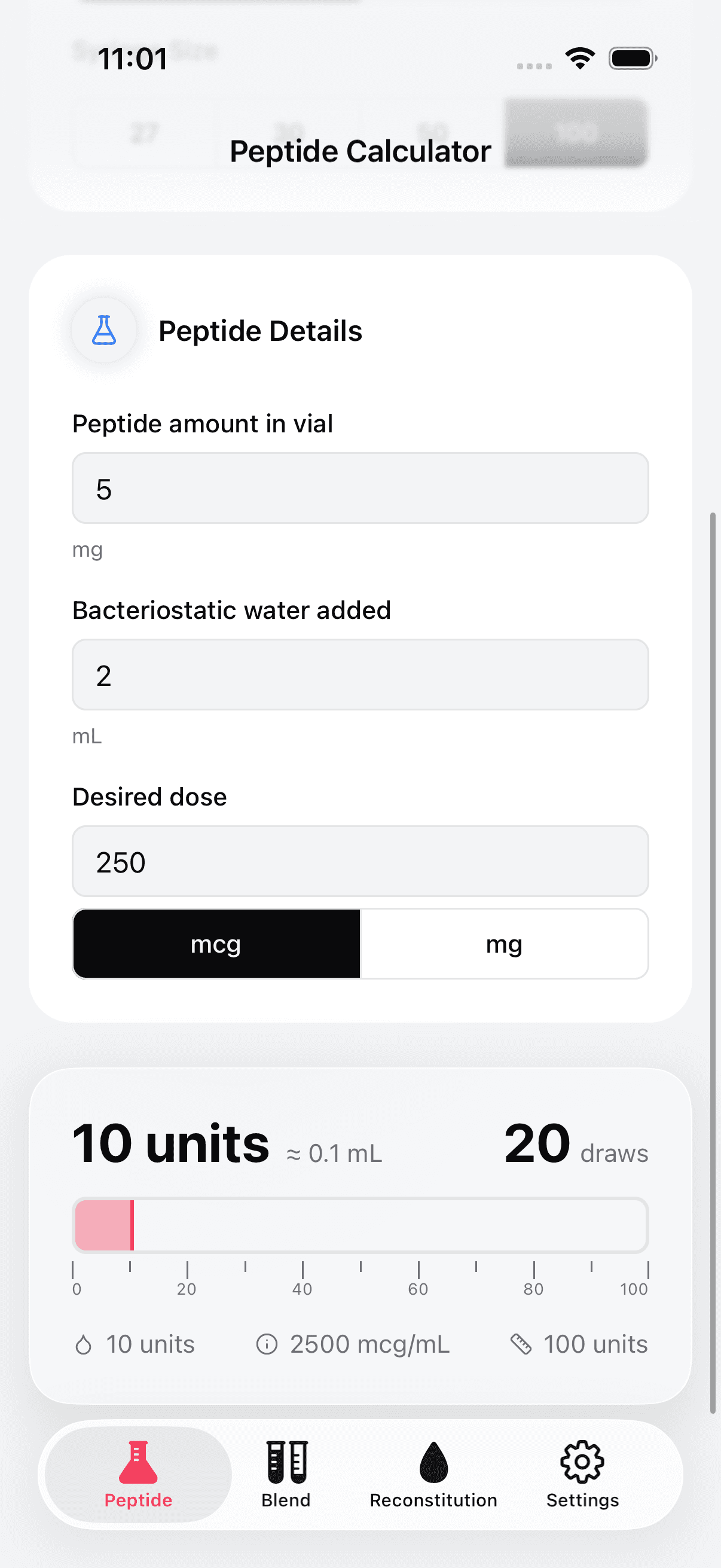
Get accurate peptide doses. Download the calculator today.