Marco Silva
March 13, 2026

Peptide Tracking for Real Life: A 12-Week Framework to Log Outcomes, Minimize Bias, and Improve Safety Conversations
Interest in peptides has grown fast, but reliable tracking habits have not. Many people start with enthusiasm, write detailed notes for a few days, then switch to memory and online anecdotes. That usually leads to uncertainty, not clarity.
A practical peptide tracking system helps you make safer, more grounded decisions. It will not diagnose a condition, replace clinical advice, or prove cause and effect by itself. What it can do is reduce guesswork, surface repeatable patterns, and improve the quality of conversations with licensed healthcare professionals.
This article is informational only. It does not provide diagnosis, treatment plans, dosing instructions, or cure claims.
Why informal tracking breaks down
Most tracking fails for operational reasons:
- logging only on unusually bad or unusually good days,
- changing metrics every week,
- skipping context like sleep, stress, travel, and illness,
- recording conclusions instead of observations,
- and not reviewing trends on a schedule.
When records are inconsistent, confidence should be low. By contrast, simple and consistent records usually produce better insights than complex but sporadic logs.
The goal: better decisions under uncertainty
Good tracking is not about chasing perfect certainty. It is about improving your signal-to-noise ratio over time.
A useful journal should help answer:
- What changed?
- When did it change?
- How big was the change?
- How often did it repeat?
- What else changed at the same time?
Question five is where most value appears. Confounders like poor sleep, acute stress, viral illness, alcohol intake, heavy training, and travel can mimic or mask perceived effects.
Build a system you can sustain for 12 weeks
If your routine is too heavy, consistency collapses. Keep the structure realistic:
- Daily check-in: 2 to 5 minutes
- Weekly review: 10 to 15 minutes
- Monthly summary: 20 to 30 minutes
A modest routine repeated for three months beats an ambitious routine abandoned after 10 days.
What to log: the minimum effective dataset
1) Product metadata and timeline anchors
Track what is objectively known:
- product name,
- source,
- lot or batch identifier if available,
- date opened,
- expiration information,
- storage interruptions (temperature issues, travel, delayed refrigeration).
Then add timeline anchors:
- start dates,
- pauses or restarts,
- notable life events,
- acute illness,
- major routine changes.
These anchors make later review far more reliable.
2) Daily symptom and wellbeing scores
Use stable scales. A simple 0-10 rating works well for many categories:
- energy,
- sleep quality,
- mood stability,
- appetite or satiety,
- GI comfort,
- headache burden if relevant,
- skin or local irritation if relevant.
Keep the same definitions over time. If you redesign your scale every week, trend analysis becomes weak.
3) Objective context metrics
Subjective notes matter, but objective data helps balance perception:
- sleep duration,
- resting heart rate,
- blood pressure if already monitored,
- body weight trend,
- activity load or step count,
- menstrual cycle context if relevant.
These are context markers, not diagnostic tools.
4) Safety observations
Create a dedicated section for potential safety concerns:
- what happened,
- when it started,
- duration,
- severity,
- what actions were taken,
- whether it resolved.
A good tracker acts like an early-warning log, not just a diary.
Separate facts from interpretation
Daily entries should be neutral and concrete.
Better: “Slept 5.4 hours, woke twice, morning energy 3/10, high work stress.”
Less useful: “This proves everything is failing.”
Interpretation is still useful, but keep it in a separate weekly section. That protects raw data quality and reduces hindsight bias.
A practical daily template
You can copy this structure:
- Date and time
- Sleep duration + quality score
- Energy (0-10)
- Mood descriptor (stable / low / irritable / anxious)
- GI status (none / mild / moderate / severe symptoms)
- Notable symptoms
- Context factors (stress, alcohol, illness, travel, heavy training, disrupted meals)
- Safety flag (yes/no + brief detail)
This format is fast enough for daily use and detailed enough for trend review.
The confounders people underestimate
High-impact confounders include:
- sleep debt,
- rapid caffeine changes,
- dehydration,
- calorie restriction,
- alcohol,
- acute infection,
- medication or supplement changes,
- intense exercise blocks,
- jet lag or schedule shifts.
If these are not logged, false conclusions become more likely.
Weekly review framework (10 minutes)
At the same time each week, answer seven questions:
- What improved?
- What worsened?
- What stayed stable?
- Did any concerning pattern repeat?
- Which confounders were strongest?
- Is there anything to discuss with a clinician soon?
- What one tracking behavior should improve next week?
Without this review step, data collection often turns into busywork.
Monthly summary: trend, uncertainty, confidence
At month end, write a one-page summary with:
- average symptom scores vs baseline,
- frequency of concerning events,
- trend direction (improving / stable / worsening / unclear),
- top recurring confounders,
- open questions for professional follow-up.
Then assign confidence levels:
- High confidence: repeated pattern, low confounding
- Medium confidence: possible pattern, moderate confounding
- Low confidence: mixed pattern, high confounding
Confidence labels reduce overclaiming and improve judgment.
A realistic 12-week implementation plan
Weeks 1-2: setup and consistency
Focus only on daily completion. Do not over-analyze. The objective is clean baseline behavior.
Weeks 3-4: context discipline
Improve context quality: sleep timing, stress load, hydration, and meal timing. Keep the same scoring system.
Weeks 5-8: pattern detection
Begin weekly pattern review. Look for repeated sequences, not isolated events.
Weeks 9-12: decision quality
Use monthly summaries to refine what you discuss with professionals. Prioritize safety signals and persistent uncertainties.
This phased approach is usually easier to maintain than trying to perfect everything on day one.
Red flags: when logging is not enough
Tracking is not emergency care. Prompt medical evaluation matters for severe or concerning symptoms, including:
- chest pain,
- breathing difficulty,
- fainting or confusion,
- severe weakness,
- persistent vomiting or dehydration signs,
- severe abdominal pain,
- significant allergic-type reactions,
- major new neurological symptoms.
If symptoms feel urgent, treat them as urgent.
How to bring your data to appointments
Clinicians usually engage best with concise summaries.
Bring:
- a one-page timeline,
- weekly averages,
- a list of products and start dates,
- a short list of focused questions,
- key safety observations with dates.
Lead with summary first, then share detailed logs if requested.
Data quality rules that prevent regret
- Log at roughly the same time daily.
- Keep metric definitions stable.
- Mark missing days clearly.
- Separate observations from hypotheses.
- Correct errors transparently instead of rewriting old entries.
These simple habits preserve trust in your own records.
How to handle missing data days without breaking your trend
Missing days happen. Travel, illness, long work blocks, and plain life chaos all interfere with perfect consistency. The goal is not zero missing days. The goal is honest records.
Use three simple rules:
- mark missing days explicitly,
- avoid backfilling from memory several days later,
- restart normal logging immediately instead of waiting for a “perfect Monday.”
When reviewing trends, treat missing days as unknowns, not silent normal days. That prevents false reassurance.
Interpreting mixed weeks: what to do when signals conflict
Some weeks look contradictory. Example: energy improves, sleep worsens, GI symptoms fluctuate, and stress is unusually high. In these cases, avoid dramatic conclusions.
A practical approach:
- classify the week as mixed,
- identify dominant confounders,
- continue the same measurement framework for one more week,
- re-evaluate after additional data points.
Mixed weeks are normal in real-world tracking. Stability in method matters more than certainty in every weekly conclusion.
Decision hygiene: avoid overreacting to one dramatic day
Single outlier days can distort your judgment, especially when symptoms are intense or emotionally stressful. A strong reaction is understandable, but immediate conclusions are often unreliable.
Try a simple decision rule:
- if a day is unusual but non-urgent, document carefully and wait for repeat evidence,
- if a pattern repeats under similar conditions, raise its priority,
- if a severe or concerning symptom appears, escalate to medical care rather than self-experimenting.
This approach keeps your process calm and evidence-oriented. It does not ignore risk; it separates urgency from uncertainty. Over time, this prevents the two common extremes: ignoring warning signs or changing everything after one difficult day.
Privacy basics for sensitive health logs
Tracking can include private health and lifestyle details. Use baseline safeguards:
- device lock,
- app lock if available,
- careful screenshot sharing,
- encrypted backup habits,
- awareness of cloud-sync privacy settings.
Treat logs like personal health records, not casual social content.
Common mistakes to avoid
- tracking only during symptom spikes,
- capturing too many metrics and burning out,
- ignoring sleep and stress,
- changing many variables at once,
- confusing timing overlap with causation,
- skipping pause and restart notes.
Avoiding these errors improves signal quality quickly.
What progress actually looks like
Progress is often quiet:
- more complete entries,
- fewer assumption-driven decisions,
- earlier recognition of warning patterns,
- calmer conversations with professionals,
- better judgment despite uncertainty.
That is the real purpose of tracking.
Final takeaway
A useful peptide tracker is simple, consistent, and safety-first. If you log regularly, review trends weekly, and stay cautious with conclusions, you can reduce preventable mistakes and make clinical conversations more productive.
No tracker removes uncertainty entirely. A good one helps you manage it more responsibly.
Educational note: This content is informational and non-diagnostic. It is not a substitute for professional medical advice, diagnosis, or treatment.
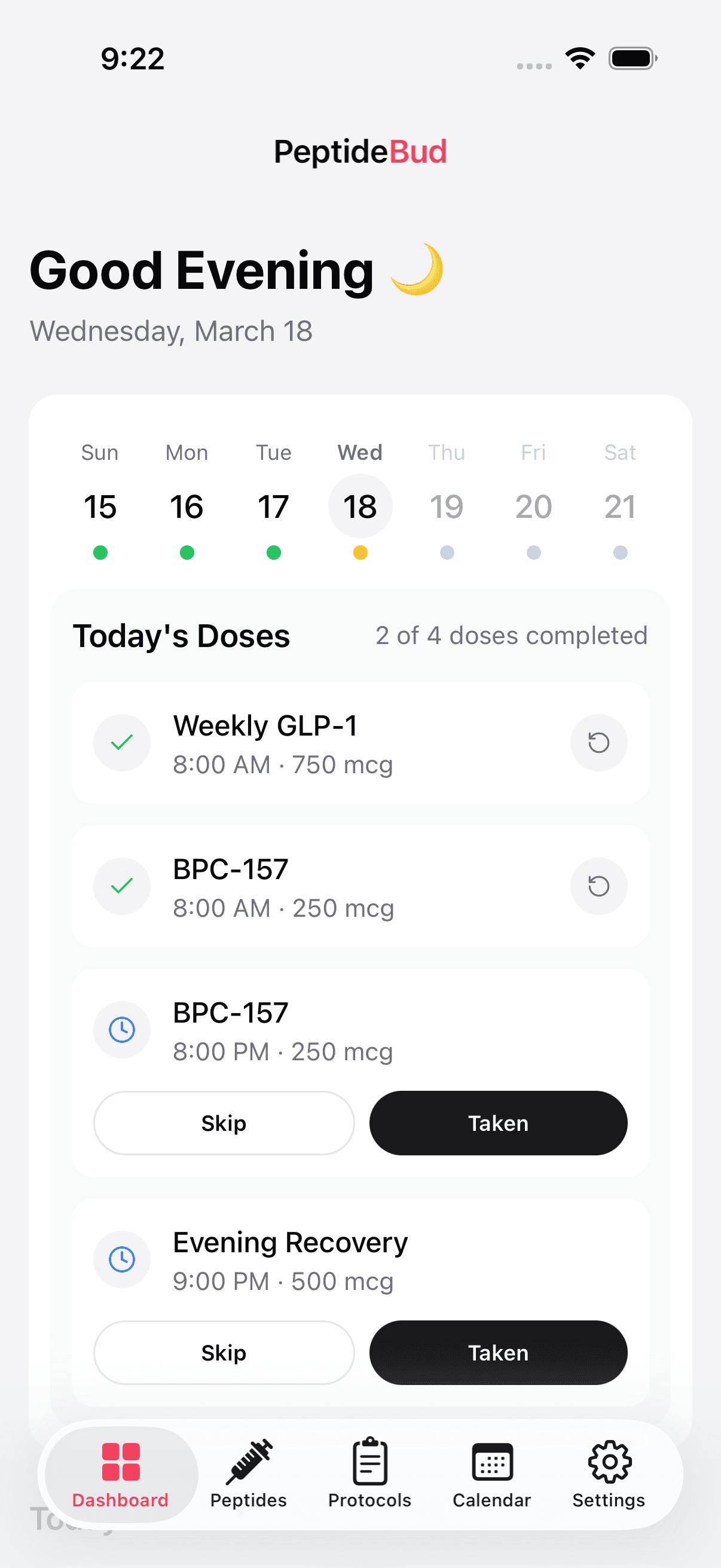
Track your peptides. Download PeptideBud today.